Tuesday, October 13, 2009

Calling All Scientists!


Who should be our environmental advocates here, really? Scientists? Or those doing it now?


In our last class we talked about whether or not scientists should actually be advocates for environmental problems. A few people agreed that they should be and others disagreed. Those that agreed sayed that scientists should be because they know the information about problems going and because they have the data concerning it right in front of them. I'd say that that makes sense. I mean who knows better than someone that has the data right in front of them (or in a desk drawer close by). Science is unbiased, its straight forward. To have a scientist as an advocate for anything could work, I actually think that it would work best. Scientists know best and I feel that instead of depending on someone else to present the information (which could end up being twisted in a way that supports their side of an argument), scientists can give the information as it is. Who do you think can be the best advocate for any issue at all?

Manipulated by a T.V.

What are we suppose to believe in? We are to believe that Global Warming and the millions of other environmental problems that are occurring, to be false or true. Agenda setting is perhaps the single most influential theory of the medias effects that applies to environmental news. According to Robert Cox, the author of Environmental Communication and the Public Sphere; News reporting "may not be successful in telling its readers what to think, but it is stunningly successful in telling its readers what to think about."


So again I raise the question...
WHAT ARE WE TO BELIEVE IN?


So we believe Al Gore's video, "The Inconvenient Truth" or should we believe that is a FRAUD? Should we believe everything that is put in the papers, because according to Robert Cox the main media organizes the bits and facts of certain events and using them to aid the stories so that the audience well be affected the way they want us to be.

What are we the Public Sphere suppose to believe in when we are told what to think about. Its as though our right to think and have an opinion on certain topics was taken away. So, the question I rise is....should you still rely on the media to know the truth or do you rely on what you see with your own eyes.


Reduce, Reuse, Recycle

Over the weekend, I saw so much trash and it reminded me of how more people should recycle to help our earth. I decided to go online and look up ways of recycling and the background on recycling. A paper company in the United States wanted to create a symbol so people would know that its products were a recycled-content. This was almost forty years ago and it started recycling. When things get recycled, it has twice the impact then burying it in the ground.

There are ten top ways on how to recycle. The first one is to reduce, reuse, and recycle. The second way is to know what can and can’t be recycled. Another tip is to buy recycled things. The fourth is to encourage an artist by giving them some of your wastes so they can make art with it. Recycle your water by using your bath or dishwasher water to water your garden or to reuse in the toilet when it gets flushed. Recycle your greenery by composting your food scraps will help your trash not fill up as quickly. Recycle your robots, which mean to send your broken electronic things back to places that can rebuild them and make them into something that works. The seventh thing you can do is to anticipate recycling by buying things that can be recycled. If you don’t love something, let it go by giving it to someone else if it can still be used. The last main tip is to become a waste-stream analyst which means you can separate your waste items so you know what can be recycled. Even if you only do one of these steps, it will still help our earth to become a better place. There are also many other things that can be done to help recycle.

To help the earth, I recycle everything I can. I have a bag in my room for bottles and I use the bins in the hall to recycle paper and cardboard. When I don’t want something anymore, I bring it to a


The girl who silenced the world for 5 minutes

I came across this speech and found it to be very moving.


This is an excellent speech presented by a 12 year old girl at Earth Summit in 1992. Cullis Suzuki's speech is very moving which is excellent in making her point. First she explains how she traveled 5000 miles just to get here and that they had to raise the money on their own. This shows how she has true determination in trying to change the world for the better. And the fact their only concerns are for the future shows that they are not at all greedy.

The way she uses first hand experiences is very powerful in presenting points. Such as how she use to fish all the time with her dad when she was younger. Now she no longer does because they found the fish to be full of cancers. Also the way she gets the audience to think is also very effective in seeing her view. She says how when she sees some butterfly or plant it makes her wonder if it will still be around when she has children. She then says that back when you were children you didn’t have to worry about that. Also she points out that you may be at this speech as a politician, business man, reporter, and so on; but remember that you are also all mothers, fathers, brothers, sisters, and etc. So remember that when it comes to making a difference in the world.

Lastly she brings back the innocent child in you. You might remember things you did or said back as a child that may be moving to you. She explains how in kindergarten we are taught to respect each other, clean up after your messes, and to share with others. She says she finds it outrageous how you do the opposite of what you want us to learn. She then ends the speech with a very touching line. She says “my dad always says you are what you do, not what you say. Well, what you do makes me cry at night”.

Local Green Yogurt


This passed weekend I was able to go home because of Unity College’s fall break. While I was home I ate some yogurt from a local NH company called Stoneyfield Farm. On the label on the yogurt container, it explained that they are organic and an environmentally friendly production. This caught my attention. I decided to go online and look at into it further and see exactly what they meant.
I discovered that Stoneyfield Farm was started in Wilton, New Hampshire, in the early 1980’s, and has been committed to responsible environmental stewardship ever since. One of their biggest goals they explained on their website was “to serve as a model that environmentally and socially responsible businesses can also be profitable”. This attitude of protecting our natural resources and environmentally communicating to the public is the very backbone of their business.
One of the biggest ways Stoneyfield Farm shows their commitment to environmental conservation is by donating ten percent of their profits every year to organizations and projects that work towards protecting and restoring the earth. In 2007 they donated a total of $1,947,109 to various non-profit organizations throughout America that included both environmental and organic programs. They explained that when looking for organizations to financially contribute to, they look for projects that protect and restore the planet and produce measurable results.
Along with sponsoring other organization to be environmentally responsible, Stoneyfield Farm continues to work hard to make their facilities as environmentally friendly as possible. Some of the ways they do this is by reducing the amount of waste, recycling, and donating unusable yogurt to local pig farms. One huge way Stoneyfield Farm conserves is by using special product materials for their cups and lids that can be recycled into useful products. A couple of examples of these products are toothbrushes and disposable razors, which are made out of their cups.
It was really great to see a large business so active in communicating to the public about environmental issues. Not only is it good for the environment, but also for their business, because customers are being attracted through the environmental attention Stoneyfield Farm is getting. They have been recognized numerous times for their efforts through national awards. These awards were won for recycling, for energy efficiencies, for tree-planting, for their emission offsets, and for their innovative efforts to reduce global warming. I hope in the future other large-scale businesses can follow in Stoneyfield Farm’s footsteps and become more environmentally friendly.
For more information on Stoneyfield Farm visit them at http://www.stonyfield.com/

Take It Or Leave It


When it comes down to science, scientists usually are right on target with the solid truth and facts about a particular environmental dispute. When an environmental dispute arises, it is the scientists’ job to research the problem and find out the threats of the problem and answers about ways it can be solved. Since the scientists job is to research these problems. The only thing they can provide is “their” answers to the problem.
A scientist’s job is unique in one way. They study an environmental concern and provide their answers. The only catch is whether you want to listen to them and believe their answers. Basically, a scientist is like a doctor. The doctor lets you know what “he” thinks is wrong with your high blood pressure for example. Yet, it is your decision to either believe him or not. The scientists’ information is information thrown in the air. Whoever wants to grab it, can. Whoever wants to let it fall, can as well. It doesn’t hurt their feelings so what ever you choose, you choose.
Lets take the environmental concern about global warming. Since scientists have told the threats of this problem. There has been a lot of stir about this problem worldwide. Many people take their information and do their part to help. While others don’ believe it at all. This is why this environmental problem becomes such a concern. People believe it and some don’t. Whether the scientists’ information is true or false. It is there for the taking. Scientists are just “early warners” of problems and they hope people will listen. They should not be looked at as anything more, like an advocate for example. They just gather their information and present it.

The Rotten Side of the Burger


Should Americans banish the burger?

That's the question posed on a "Larry King Live" interview. Millions of Americans eat ground beef daily without problems. However, that same meat may be contained with E. coli bacteria -- which has sickened, paralyzed, and killed some individuals.

E. coli bacteria is only on the surface of meats, and thus can be destroyed when cooked. Yet this rule doesn't apply to hamburgers because the meat has been ground up; the bacteria is inside the meat. To quote Bill Marler, a source on foodborne illness litigation: "...During the slaughtering process, those guts are nicked or there's fecal material on the hides. It gets on the red meat," Marler explained to King.

But Patrick Boyle, the president of the American Meat Institute, insists that foodborne illnesses have decreased in the United States 60 percent in the last decade. E. coli, he states, can be killed through cooking or irradiation (the later is not commonly used).

Then Dr. Colin Campbell of Cornell University made his comment. He said that Americans should aim for a plant-based diet for overall health. This man is not corrupted by bias. In fact, he was raised on a dairy farm with the firm belief that animal protein is essential to the human diet. His opinion changed only upon years of research. His opinion was then challenged by Nancy Rodriguez at the University of Connecticut, who feels that animal protein in moderation is essential for health. She suggests that people consume about 200 calories of meat, or a three ounce serving.

The experts continued their debate, bringing up powerful points to aid their opinions. But the fact still remains that some things cannot be forgotten. Take for instance 22-year-old Stephanie Smith, whose nervous system was attacked by E. coli through contaminated meat. She is paralyzed, her brain is damaged, and she could suffer from kidney failure. She is now in rehabilitation therapy but her progress will be difficult. What's the most tragic is that she longs to dance again... but it's unknown if she'll even be able to walk.

Another tragic story: Barbara Kowalcyk, the director of food safety at the Center for Foodborne Illness Research and Prevention, lost her 2-year-old son from the bacteria. He was healthy and then died within 12 days.

Although the above is more of a health issue than an environmental one, I feel it is a perfect example of communication and debate. (In addition, I have always felt there is a powerful link between the environment and health.) There was an interview, experts from both sides, and the issue was a hot one. In the end, what is more important? Health risk or satisfying our appetites? The answer may seem obvious, but think about your daily choices. Chances are you consume burgers...

Where do I stand? I eat meat... even though I know the full consequences, from environmental (yes, there are environmental impacts) to ethics to health. This is a field I am highly knowledgeable in, as I have written theses and was a vegan for 2 years. I can say with 100% truth that I was healthier as a vegan. My skin was clear, I weighed about 20 pounds less than I do now (without exercise!), my blood pressure was absolutely perfect, I felt more energized, my asthma improved, and I never once had a cold. What was perhaps the greatest of all, though, was the dramatic weight loss. I went from 168 lbs. to 110, with no exercise, in under a year. All of the benefits have gone away upon consuming meat and dairy again, and I only have two reasons for doing this: 1) It's more convenient, because so many products contain meat and/or dairy and 2) it's tasty. But having read this article, and adding it to my bucket of previous readings, I am again questioning if those two points justify harming my health.

Hmm...

What's your opinion on this issue? Do you agree this article is a great example of communication and debate?

Source: CNNHealth.com article.
Image Credit: Here.

Monday, October 12, 2009

Questionable Questions Questioning Me!

Do you ever look at a question and think, well what the heck does that even mean? The question causes you to think about it, and then you question the question and then you are like, well, what the heck!? all over again. Well, while I was meandering through the blogs I caught the blog prompts for this week, and the same "what the heck?!" question was haunting my life: from class to blog. So, I figured I'd give it a stab and try to make sense of it, or at least not make sense of it so it makes sense that it doesn't make sense (does that even make sense?).
This question, on Blog Prompts, consists of asking us to make a list of legitimate authorities that could change or inform issues and policies regarding climate change. So, my little personal list consists of the economy (because it rules a lot of decisions), religion (because some religious people follow whatever their religion sees as correct), and the president/congress/ all those political people (because they are important to people). 
So, while I'm thinking through these, I'm realizing that other than scientists, no one really cares, so no one would really care too much about climate change. Honestly, is the economy going to move to purely "green" things to sell and trade with other countries? Well, our economy will be practically non- existent if we do that. Though environmentally friendly things are great, they are expensive, and only a few people can actually afford going green.
So, moving to the next group because the economy would bag going green pretty quick. Religion makes no sense to me whatsoever. How could religion help the environment? What, are priests/rabbis (that's really all I can think of for those things) going to do? Call down on God/Buddha/ ??? and then God/Buddha/??? is going to say "Help the Environment!". Like, I know there are sacred things in the Bible (and I'm Catholic so I'm not against religion at all)and such that involve the environment and stuff, but as a priest/whatever, you can't just say "well, God says No to climate change!". What did you just float up to Heaven for a night and have a nice chat? No, probably not, I mean, unless some great miracle occurred. So the validity of a preacher preaching about how God does not want climate change is not very legitimate if you ask me.
Next I thought of Political Figures. Yup, the climate is pretty important, but I think their minds are more filled with Health Care, Terrorism, Wars, Economy, and all that important stuff. I mean, if the environment was the primary concern of the world (wouldn't that be nice?), then yeah the Government could totally help. But, climate can easily be shoved in the back burner if something more interesting comes up.

So, after thinking about how these groups affect the public and peoples views on important things, I thought wow climate change would be pretty insignificant without scientists. 
After going through this long epic process, I thought back to the question. And I got back to my normal "what the heck!?" response. Other than science!? Well, if science was non-existent or was paid less attention to than everything else, hmm... how would we even notice global warming? Without scientists, who would take charge to even recognise it? Then how does this question even make sense. What the heck.

Scientists in Our Communities

Imagine you are living in a town with polluted water and land, resulting in unsafe drinking water and contaminated playgrounds for your kids (where would the children play?) Asking for the government’s help alone may not be very effective in solving the problem. Instead, your town will probably need scientific facts on the exact quality of the water and land and the consequences of the pollution to the community in order to get your voice heard. In this way, science is probably the most important part of an environmental problem. Researching the problem is key to understanding the situation and finding a solution.


The streams in my town and state have been monitored by scientific organizations that get the public involved. In 2005, I was part of a group of more than 30 volunteers that surveyed a stream near my home as part of a River Watch Program (see picture). After going through a short training workshop, we went out into the field to record different features of our section of the stream, such as how deep, how wide and how clear the water was. We then submitted our information to the science organization to be compared to previous years’ results. The River Watch Program has shown that not only scientists are gathering evidence on environmental issues, but the public, on a local scale, are being encouraged to get involved. In this way, scientists are acting as researchers, advocates and public supporters and I think this is the way it should be.

If anyone is to be an advocate for environmental issues, scientists should. If they don’t someone else will, whether it’s the government, religious organizations, or the general public. Since scientists probably have the most accurate and fact-based information regarding any environmental problem, they should have the ability to influence the public to act accordingly.


For example, if the government is given primary authority, they might focus more on the problem of funding an environmental cleanup rather than on the health and safety of a community. They might therefore conclude that the problem is not worth fixing (perhaps even end up like the video above). While funding is a legitimate problem, I don’t think money should be the primary focus of a problem that could lead to more danger.

Religion should also not be the authority for deciding on environmental actions. Unlike religion, there is generally only one belief in science. While both are, in some way, universal, science is often given more credit and is therefore less opposed to than many religious beliefs.


I think scientists have priorities to manage the health of the planet and its inhabitants and therefore should be given primary authority in the case of any environmental issue. When facts are publicized, they are based on what scientists, and the public in cases like the one mentioned above, have discovered. Since these scientists have discovered the problem and are most likely to understand the true nature of a situation, they should be the ones to not only educate others about the problem, but offer solutions to fix it.

Sunday, October 11, 2009

Unity College has Competition!

The Impressive EcoDorm at Warren Wilson College.

Unity College, proudly sporting the slogan of “America’s Environmental College” should keep watch on tiny Warren Wilson College. While Unity House (the sustainable home with solar panels on its roof which you may have seen) is the abode to the UC president Mitchell Thomashow, it seems that WWC has an even more remarkable building. This school, located in Swannanoa, North Carolina, has the EcoDorm.

It is a residence hall with “green” at the very essence of its core. It has a rainwater-collection system, kitchen cabinets created from recycled fence-posts, a permaculture system, and composting toilets. Even the wood siding is eco-friendly: It was taken from trees on campus that were ill from pine-beetle infestation. The EcoDorm hosts 36 students “who have sworn off hair dryers and gravitate toward acoustic music.” They have linked their actions with their values -- something which Unity College students (myself included!) should acknowledge and admire.

Surprisingly, the EcoDorm produces almost two-thirds less electricity than a typical building of the same size would.

But the hype is not limited to just WWC. Nationally, colleges are aiming for sustainability and 600 schools have pledged to become carbon neutral. Approximately 90 residence halls are LEED certified, although EcoDorm is only one of two which has LEED’s platinum rating.

I am delighted that colleges nationwide are becoming more aware of environmental sustainability and are incorporating it into their housing. Perhaps in time there will not be only one “America’s environmental college”, but rather a collective of American environmental colleges! And UC, watch out; looks like you have competition!

Friday, October 9, 2009

Share Some Knowledge With Someone

http://www.youtube.com/watch?v=phcPLg22pkk

This movie clip and so many others on environmental issues are so extremely moving. In our free time as college students, we tend to get carried away on the internet and look at this site more than ay other: YouTube. But instead of watching movie clips that share knowledge about the world around us, we watch silly videos of Joe riding his dirt bike and getting stuck in the mud. Personally I wonder what the higher authorites, such as people in congress and maybe even the president, do in their free time? I would assume they try to spend a lot of it with their families after a long day of work in the office. But what if they spent some of that time on YouTube? Would they learn about the world around them and how it is changing due to the toxins their cars and SUVs emitt everyday as they drive to and from work? Would they teach their kids how to recycle and compost? I realize that the president and even congress are trying to change some things to help heal this
planet, but when do they here from the public? How many of us have written to our senator? I think that if these higher authorities were to watch a couple of informational movies on YouTube, they might understand how much we do actually care and want to make a difference for this planet and future generations. Hey, maybe we could send them this blog website!

Now That's What I'm Talking About!

I hate to do embarass anyone here, but I just gotta do it...

Two recent posts by Valerie and Molly illustrate two different, but really powerful approaches to blogging.

Molly's "Contradictory Lifestyles" post demonstrates a familar, highly personal, and provocative approach to blog success.  Now that's a post that goes by quickly, invites a response, directs the reader to more information (about themselves), and is just plain entertaining.

Valerie's "Violent Elves on a Rampage of Destruction," is full of careful (and interesting) information, offers a well-thought out opinion, and invites contradictory views.

I wonder whether there is a third way to offer a really powerful post...

Wednesday, October 7, 2009

Blog Prompts | Oct 6 - Oct 13

Other than science, what grants an individual, a public official, an advocacy group, a policy, a source of knowledge, or an approach to a problem authority and legitimacy in our society? Make a list. For each entry on your list, imagine that source of authority matters more than science. How would that change or inform issues and policies regarding climate change?

What is the proper role of science and scientists in public environmental disputes? How is a scientist like or unlike a doctor in this regard? Are scientists properly thought of as “early warners?” Should they be advocates as well?

Have a look at the Union of Concerned Scientists investigation into the Bush administration's policies regarding science production and publication. Under what circumstances should the government influence scientific findings, or edit the publications of government employed scientists?

Tuesday, October 6, 2009

Diesel Power

Over the past years i have worked for a company working on Yanmar diesel engines. When i first started i really didnt care about what i was spilling into the bilge or out into the water. Then I came to realize that i wanted to be a Conservation officer and the major goal is to protect and serve wildlife. Nearly all of the boats i worked on were in the water and all of the contaminants that is was spilling was going into the water. I went to my boss and asked if he had anything to prevent the contaminants from going into the water he said "no". I told him how big of a problem it was and he agreed with me and we started looking in some books and found a solution. I ordered some things called "pig blankets" they only soaked up oil and dirt and fuel but they didnt soak up water.I took them on the boat with me and when i spilled some diesel fuel and oil i tried the "pig blankets" and they worked amazingly. \I was pleased I was able to help the environment and it made my boss happy because he didnt have to worry about getting any fines for dumping contaminants into the water.

Why fill it up when you can plug it in?

I recently learned that our school didn't make the top ten list in the enviromental schools. One of the reasons that we didn't get on the list is because of the fact that we have poor transportation ways. Now I think the reason for this is because we live so far away from things like stores so when people have to go and buy something they have to travel so far and there's not much that can be done about that.
But I can think of a way to make things better for traveling close to campus like going to spanky's. The school could buy electric golf carts for the students to rent out and that would make such a big defence in the amount of pollution that we put in to the air as a school and I think that would be a huge help in getting us on to that top ten list of enviromental schools.

The Most Effective Mode of Advocacy

Of all the Modes of Advocacy which one do you think is the most effective? I would have to say Political Advocacy would be the “most” effective. Meaning if you could only use one mode I would use this one. In order to actually make a change though, I feel like you have to use every mode at your disposal. The reason I believe this is the most effective is because you are dealing with the people who ultimately vote and pass bills that we have to go by. Notifying the public about certain environmental issues that are going on in the world lets people know of our current issues. However, it doesn’t necessarily get us anywhere. A lot of people might not like things that are currently happening in our world but they usually don’t go about trying to change it. I hear a lot of people complain about issues on our campus such as selling bottled water in our SAC. But how many of these people try to do anything to change that? There are a few such as those who belong in the Constructional Activists Club but that only makes up a small percentage. The best way to go about changing something is to communicate with the higher power that can actually make a change while still trying all the other modes of advocacy. And lastly don’t give up because making changes are not at all easy to do. We can make a difference, but in the corporate world we live in today, it doesn’t come about easy.

On a bit of a different note, here is a video you might find interesting. It's a SNL skit that was only aired once on TV.

conspiracy theory rock

Wake up!


Do you agree that relying on the worsening of environmental problems to wake people up is an effective strategy for making real change? I don't. I think that waiting for a problem to get worse until we take action to make it better might not give us enough time to actually fix that problem so that it can, in fact, get better. What if it's too late by the time "people have woken up?" What do you do then? There really isn't much that you can do if it is too late. Waiting for things to get so bad that people are finally like "oh crap, this is a problem" is just cutting it way too close. Waking up, is just too late to wait. I mean if there are people that know there is a problem, why wait for it to get so bad before doing something about it, just so that it will have the attention of other people? If we do something before it becomes worse, maybe we could stop it from actually being a major issue, such as climate change. As long as there is someone that knows about it, is there really a reason for it to worsen? I don't believe so, but what do you think?


McFlurry of Disaster


I think Green consumerism is the best out of all the Mode of Advocacy. Green consumerism is as defined by Cox is, “To use consumers’ purchasing power to influence corporate behavior.” The Green consumerism is the most effective because I feel that it is the strongest. I feel like it makes the most difference.


I found an article that represents Green consumerism really well. The article is of a hedgehog that got its head stuck in a McDonalds McFlurry. There is also a picture that goes along with it.

The article states that many hedgehogs have gotten their spiky heads caught in the lid and died of starvation. Many people complained about this to McDonalds and they finally changed the design of their lids. When the people complained about this, they said they wouldn’t eat at McDonalds again until they changed it. This has only been a problem in Britain, thankfully it hasn’t been a problem in the United States of America.

Environmental Protester or Adrenaline Junkie?

I was on the computer today when I found this interesting article by Greenpeace. This article talked about Greenpeace demonstrators in Italy protesting coal power plants because of the pollution they create. These protesters climbed over 200 meters to the top of massive chimney stacks that tower over the power plant below. The protesters hung banners about global warming and refused to come down. This protest actually temporarily prevented the power plant from feeding coal and producing greenhouse pollution.

When I first saw this Article I immediately saw how it was an excellent example of “Direct Action” in Robert Cox’s list of Advocacy Modes. In Cox’s book Environmental Communication he describes Direct Action by saying “To Influence Specific Behaviors Through acts of protest, including civil disobedience.” I think Direct Action is the strongest and most influential Mode of environmental advocacy. It is quick to grab your attention and can come in many forms. I believe these climbers atop the chimney stacks in Italy demonstrate Cox’s “Direct Action” extremely well! It also shows just how far some people are willing to go in order to communicate their perspective in the form of protesting.

Monday, October 5, 2009

How Powerful Can A Teacher Be?


Being in an environmental based class, you are faced with many different environmental issues. Whether it is global warming, the effectiveness of recycling, or cutting down rainforest's. It opens your eyes and gives you more than one look on a certain situation and problem. You try and figure out different ways to successfully accomplish each issue in a positive way. In the end, You are now educated on certain issues and ways to successfully fix them.

To me, my class "environmental oral communication" is an excellent example of public education. In the list of Advocacy Modes, Public education is "to influence societal attitudes and behavior"(Cox 228). I believe Public education has the most impact of all the modes of environmental advocacy. Take our class for example, not only does our teacher tell us different issues and problems. He teaches us about the problems and explains to us different ways to attack each problem and come up with ways to solve them. This is the best mode because not only are you told, you are taught. Our teacher John, makes sure we understand thoroughly. Basically, I believe this is the best mode because a teacher can educate us on certain subjects like "going green" and educate us one on one. Rather than trying to get through to someone through a picture. Public education is just the most sensible and can be understood a lot easier. In the end, Public education gets through to a lot more people easier and has a big impact.

Boaters Behaviors


Two summers ago I realized something. I do a pretty good job at keeping my own living space prim and proper, recycling what should be recycled and not littering the ground with my trash. However, as I venture out of my own comfort space I tend to forget my habits and don’t care as much when I see the rest of the world used as a dump.
As I sat besides the fire at the boat club I belong to and watched the flames dance and crackle to life I also noticed several bottles and cans tossed in along with the wood. I have always been a fan of recycling, especially cans since they seem to be the easiest to sort and so I began to wonder why after all my life of belonging to this club I haven’t decided to bring my habit of recycling to one of the places I love most. Truth is I didn’t feel obligated to keep any space that wasn’t my own clean and until that moment and I never really even noticed all the bottles tossed in with the fire. I’m sure I’ve tossed a few in myself more than once. But the more I thought about it I began to notice that there was a complete lack of recycling bins. At home I always have the recycling box close by and because it’s so close I feel motivated to do good and recycle. The reason I didn’t recycle here was so ridiculously simple: there was merely no recycling bins. I actually had a good laugh at how silly it was that I could forget my good habits simply because there was nothing to remind me but that just goes to show how forgetful the human mind can be. Ironically this was also the summer that my dad had been elected as the club’s president and both my mom and I had the same idea to start implicating recycling. He agreed and thought it was a great idea and so we placed several big blue bins around the pavilion.
The next time I sat down besides the fire I couldn’t help but smile. Not a can or bottle was to be seen because behind me the recycling bins were filled.

Now that I realized my actions reflected on what was around me and what was influencing my behavior I‘m now more conscience of my surrounding environment. But it now also makes me wonder why there aren’t more recycling bins in public places. In my opinion people are willing to help out the environment as long as it isn’t too much out of their way.

ROAR for the Future

Reach Out. Act. Respond. For animals. That’s the message of the Roar campaign, launched by Animal Planet in 2006. If you’ve ever watched Animal Planet, you’ve probably seen advertisements for this widespread campaign. The success of this campaign is most definitely due to several factors:

The goal: This campaign was launched to benefit animals around the world, by helping to prevent endangerment of wild animals or to find homes for the stray cats and dogs all over the globe. This is a clear goal with a wide range of opportunities. The goal is to improve the lives of these animals through protecting species habitats, conservation and pet health care.

Objective: A clear objective of this campaign was to gain world-wide supporters in the form of organizations and Federations. Just a few partners of the campaign include the American Humane Society, National Wildlife Federation, Roots and Shoots, World Wildlife Fund and Wildlife Warriors. These groups represent other organizations from around the world to help spread the message of animal health and conservation.

Audience: Through the use of the media, Animal Planet is able to reach worldwide audiences, more specifically to those of us who find animal health and education interesting enough to watch shows like Animal Precinct, Crocodile Hunter, Jeff Corwin, Animal Wars, just to name a few. These are all shows broadcasted on the Animal Planet network. These shows reach viewers everywhere and help to introduce animal awareness to everyone.

Strategies: The strategies of this campaign all center around education. Using television as a key tool, Animal Planet broadcasts information and inspirational videos, like the one above, on their network. This also allows people of all ages and backgrounds to hear the message and learn more about what they can do to improve their animal community.

Tactic: The Animal Planet’s ROAR website is a great tactic for informing the public about the need for animal conservation. This website provides further links for adopting pets, information about their causes and issues, and other ways to get involved in the project.

The message: ROAR. Animal Planet’s campaign message is a simple and catchy message that clearly defines the goal to improve the lives of animals throughout the world. The message conveys the strength and power of the project, motivating people to get involved and make a difference.

Though this campaign was launched in 2006, the message is still going strong today. As you can tell, when a huge amount of effort is put into a good advocacy campaign, the message speaks volumes. Are you ready to ROAR?

Contradictory Lifestyles?


After neglecting to clean the fridge at work (large cafeteria) for a week, I knew I would find some gross stuff. Sure enough, I did. And man, was it a TON of rotten food. My friends and I filled 2 trash cans with rotten fruits, vegetables, chicken (grossest smell EVER!), and old soups and sauces. We obediently brought the bags as quick as we could over to the garbage bins, hoping that they wouldn't rip all over us (because we would have quit). After this disgusting day at work, I went home to eat some fruit, and since it was just a terrible day, the peach I wanted to eat was moldy. So, I threw it in the trash. Now, I am living on my own.
The other day my friend came over (while I was again, cleaning the fridge. My life is just haunted by fridge cleaning). She watched me throw all kinds of old rotten fruits and vegetables and cheeses in the trash can, just shaking her head. "Molly," she said, " I thought you were all about recycling and reducing waste?" I was dumbstruck. "Well of course I am!" I said. "Well, then why are you throwing all that food in your garbage can instead of composting it?"
Dang, she got me. That got me to thinking, how much am I really doing to help the environment? I mean, I obviously care about climate change, and I recycle everything recyclable, but is that really enough? I was curious, so I went to see what my Carbon Footprint was, and got the following graph.
Now, I knew it could be better, but compared to the rest of the country, mine wasn't too bad. Of all the underlying categories, though, my biggest footprint was in the food category. My friend was right. I was a member of the attitude- behavior group, which is the "all talk, no action" group. I talk and talk about how I want the planet to be saved and how I try to help the environment so much, and here I am, with a pretty big food footprint because, well, I'm too lazy to separate my food into compost instead of garbage, and I always have been. I really didn't like that title. Me, being someone in the attitude-behavior group? That's upsetting. I guess I should probably work on that, huh?

The TAP...the World's Source of Water

A recent New York Times article by Charles Duhigg states, “Jennifer Hall-Massey knows not to drink the tap water in her home near Charleston, West Virginia. In fact, her entire family tries to avoid any contact with the water. Her youngest son has scabs on his arms, legs and chest where the bathwater, polluted with lead, nickel and other heavy metals, caused painful rashes. Many of his brother’s teeth were capped to replace enamel that was eaten away. Their neighbors apply special lotions after showering because their skin burns. Tests show that their tap water contains arsenic, barium, lead, manganese and other chemicals at concentrations federal regulators say could contribute to cancer and damage the kidneys and nervous system. When 264 neighbors sued nine nearby coal companies, accusing them of putting dangerous waste into local water supplies, their lawyer did not have to look far for evidence. As required by state law, some of the companies had disclosed in reports to regulators that they were pumping into the ground illegal concentrations of chemicals, the same pollutants that flowed from residents’ taps.”

The government decided to instate The Clean Water Act (CWA) which gives the environmental protection agency (EPA) the authority to set effluent limits on an industry-wide (technology-based) basis and on a water-quality basis that ensure protection of the receiving water. The CWA requires anyone who wants to discharge pollutants to first obtain an NPDES permit, or else that discharge will be considered illegal. This act was initially put into play to help the American people feel safer about their drinking water. But the question is does the act really do its job? Do you feel safe drinking tap water? In the last five years alone, chemical factories, manufacturing plants and other workplaces have violated water pollution laws more than half a million times. The violations range from failing to report emissions to dumping toxins at concentrations regulators say might contribute to cancer, birth defects and other illnesses.

However, despite all that, the “Take Back the Tap” campaign asks people to choose tap water over bottled water. And I know what you are thinking because I’m thinking the same thing why would I choose polluted tap water over clean bottled water? And the question I rise is how “pure” is bottled water than tape water?

Contrary to what the bottled water industry would have you think, public tap water is healthy, safe and monitored. In fact, the EPA requires extensive testing of public water for both organic and inorganic contaminants. When, in some communities, public water systems fall short of consistently meeting EPA standards it is likely due to pollution of the water source, inadequate water treatment, or deteriorating infrastructure. Federal, state and local governments must protect the quality and integrity of our water sources. That means full enforcement of the CWA.


Watching bottled water ads, you'd think that tap water might not be healthy. But it's not true. ABC wrote an article that stated, “Five bottles of national brands of bottled water and a sample of tap water from a drinking fountain in the middle of New York City was sent to a microbiologist, named Aaron Margolin of the University of New Hampshire, to test for bacteria that can make you sick, like E. coli. He said and I quote, "There was actually no difference between the New York City tap water and the bottled waters that we evaluated.” Many scientists have run tests like that and have consistently found that tap water is as good for you as bottled waters that cost 500 times more. Case in point: Dasani, a Coca-Cola product. Despite its exotic-sounding name, Dasani is simply purified tap water that’s had minerals added back in. For example, if your Dasani water was bottled at the Coca-Cola Bottling Company in Philadelphia, you’re drinking Philly tap water. But it’s not the only brand of water that relies on city pipes to provide its product. About 25 percent of all bottled water is taken from municipal water sources, including Pepsi’s Aquafina.

Noting the problems associated with large scale consumption of bottled water, the Take Back the Tap campaign asks people to choose tap water over bottled water.

Facts

§ Bottled water costs consumers 240 to 10,000 times more per gallon than tap water, and is less likely to be ensured for purity.
§ Americans bought a total of 31.2 billion liters of bottled water in 2006.
§ That required over 17 million barrels of oil.
§ And 3 liters of water for every liter made.
§ 2.5 tons of carbon-dioxide where released that year from bottled water production.
§ Cars produced 27 million tons a year….
§ Which means bottled water produces 10% the amount of CO2 that driving does.
§ Recycling sounds great, but according to The Container Recycling Institute, 86 percent of plastic water bottles used in the United States become litter or garbage.
§ Americans hold some notion that bottled water is safer than tap...but in reality it all water (H2O).


TAKE BACK THE TAP!


Blog Prompts | Sept 30 - Oct 6

Just in case some of you might need a couple of ideas...

Have you ever been part of an advocacy campaign?  Either environmental or otherwise?  Describe some of the tacts you used and how successful they were.

Have you noticed the attitude-behavior gap at work in your own life, or the lives of those around you?  Give an example (be careful about "outing" anyone other than yourself.) What do you think accounts for people's seeming unwillingness to "walk the talk?"

All things being equal, which of the modes of advocacy do you think is most effective?  Why?  Give an example.

Friday, October 2, 2009

Up The Creek Without A Paddlefish

"The Chinese Paddlefish, Psephurus gladius, is on the verge of extinction" states Andrew Revkin on his blog, Dot Earth. This colossal fish grows to be about 20 feet long and could be found in the Yangzte River in China. But no more. Soon Revkin writes, the paddlefish will be listed as an endangered species on the Endangered Species Act. This act is intended to save creatures on the brink of extinction, but why is there not an act intended to monitor and sustains diverse ecosystems before bad things happen? I believe that there should be an act to monitor and preserve diverse ecosystems. This act should also support the species found there. Could a campaign be created to obtain the goal of an act that would do these things? YES!
The goal of an environmental campaign is a long term vison or value (Cox, 234). In this case the goal for this campaign would be to create or have an act passed that monitors, and sustains diverse ecosystems if they are showing signs of trouble, such as extinction. The objective, a specific action or decision that moves a group closer to a broader goal (Cox, 234), would be to gain the attention of congress and write a rough draft of the act for congress to view. The next step is to figure out who the primary audience for your goal is going to be. In other words, the descision makers who have the auhtority to act or implement the objectives of a campaign (Cox, 235). The primary audience then could be the United States Congress. The secondary audience, or the various segments of the public, coalition partners, opinion leaders and the media (Cox, 235). The secondary audience is going to act as the leverage to help you and your campaign gain favor in the eyes of the primary audience. This audience might be the public and the media so that your campaign is learned and heard about.
Next, choose a strategy; a specific plan to bring about a desired outcome (Cox, 236). in this case, the strategy would be to educate the public about the endangered species and why the new act is such a good idea. It might also be a good idea to bring democratic polictics into the picture. "The use of democratic polictics in environmental policy involves attempts made by advocay groups to mobilize constituencies to influence public officials accountable to protect the environment." (Cox, 237) Tactics are the specific actions that carry out or implement the broader plan (Cox, 237). Meetings, public protests, briefings and so on, are examples of a tactic.
Can the paddlefish be brought back from the brink of distinction or is too late? What about the snow leopard? The humpback whale? Maybe they can't be brought back from extinction, but other species can definently be prevented from going there, we just need to convince others that this is true. This act, to monitor, and nourish diverse ecosystmes can make a difference!

Thursday, October 1, 2009

Violent Elves on a Rampage of Property Destruction

A multimillion-dollar home destroyed by arson.

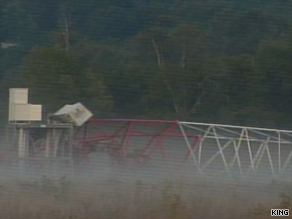
The remains of a radio tower toppled over by ecoterrorists.

Some tactics are more extreme than others. In the process of trying to make a goal clear, some individuals and groups fail due to violating laws.
On September 5th, 2009, a pair of radio towers near Seattle were destroyed by what some believe were "Elves". No, these weren't Santa’s elves of course, but rather the collective term for members of the ecoterrorist group called the Earth Liberation Front (ELF). In an e-mail from the North American Earth Liberation Front Press Office, it was stated the KRKO-AM towers were toppled due to environmental and health concerns. Jason Crawford, a spokesman for the extremist group, stated: "...Local residents do not need additional sports news radio towers that come at the expense of reduced property values and harmful radio waves."

The ELF consists of radicals that are accountable for numerous attacks since the '90s. Authorities found a banner with the initials of the group at the site. The crime scene is now being investigated by the Federal Bureau of Investigation (FBI).

In a course of over ten years, KRKO-AM has desired to increase its transmission capacity by constructing more towers in the area. However, the area has been subjected in appeals and litigations over problems such as harming trumpeter swan habitat to possible human health risks.

This is only one example of destruction done by the ELF. In 1999, Marie Mason and other "Elves" set fire to Michigan State University's Agricultural Hall, resulting in over $1 million in damage. Mason is also accountable for $3 million in damage via other incidents, such as setting fire to boats owned by a mink rancher and annihilating homes under construction around Detroit and Indiana. Another incident: Three seven-figure homes were set aflame in a Seattle suburb; on the spot was a sign ridiculing the builders' claims that the houses were eco-friendly.
The above stories are disturbing to me, but not shocking. I was already aware of the ELF prior to now. What is your opinion on them and other extremist groups? Do you feel they get their point across (that humans are ravishing the Earth of its precious resources and it must be safeguarded), or do you think they've crossed the brink between sensibility and craziness? Personally, I appreciate their philosophy but I am repulsed by their actions. I feel there are more effective and legal ways to address environmental concerns. Groups like the ELF make all environmentalists look bizarre (at best) and look like misanthropic terrorists (at worst). In your opinion, what are alternative ways to promote environmental protection?


Sources:

Tuesday, September 29, 2009

Hey I'm like Angelina Jolie!


Ever wonder why people buy those expensive clothes that celebrities buy? You know the prada bag that "Paris Hilton" wore last sunday. It is because when you look like them you, in a way, feel like them, or at least you think you do. This is why environmental activists want celebrities to become their "icon."


When famous people care for the environment their fans start caring for it too. The majority of people do not listen to what their politician says instead they are too busy listing to their favorite musicans song or watching them on t.v, that is why instead of trying to address the public the poloticans mostly address the people in the media because they know that to get to you they need to get to the media first. Celebrities are like the opinion leader, once they state their opinion to the media their fans will react either in a positive or negative way. They can do something big like Pierce Brosnan who mainly works with protecting marine mamals and wetlands to Kt Tunstall who ran her tour bus with biodisesel fuel, either way their fans will see their act of helping the envrionment and hopfully it will influence them to do the same.


I find this to be a great tatic to making the public go green. Of course these celebs are being green for their own personal reasons as well but they also know how influental they are to their "follower's." But do we really need someone to tell us to be environmentaly freindly? Are we that "brain washed" to only listen to what they say that we can not act alone? I remember how that was for fashion, how teenagers would only wear what the celebrities would where, is that how we are now about being green? I hope not because then we can never advance without a famous person doing it first.


Women Against Fur

Yesterday I was online looking at environmental protests on PETA’s website when I saw these pictures that caught my attention. Their title, “We would rather go naked then wear fur” was catchy and made me want to look into it. This slogan was in fact a campaign that that People for the Ethical Treatment of Animals (PETA) launched in 1991 to raise awareness for the millions of animals trapped and killed for their fur. PETA is the largest animal rights organization in the world, focusing on animals suffering in factory farms, in laboratories, in the clothing trade, and in the entertainment industry.
Personally I believe that when done humanely trapping can be a great management tool, however PETA has a very different opinion. When I saw this add though I thought it was an excellent example of Kevin DeLuca’s image event theory. Images can be an excellent way to get your point across when protesting and can create an influential environmental communication to the public. In this case PETA’s anti-fur campaign is shaped primarily by images. These pictures show how involved and committed the girls are to the cause while simply explaining the problem with a picture. I thought these pictures were well taken and they are an excellent example of a “picture event”.

Stopping KFC in Bikini's


So I was browsing the web this past weekend and I came across an organization called Peta. It is an organization set up to protect the rights of animals throughout the world. Peta is one of the biggest animal rights organization in the world today. It is made up of about two million members and supporters. It is a very successful group which catches a lot of eyes from the public.


Researching the Peta organization I found many strong image events. "Image events fully take advantage of television's hunger for pictures"(Cox 162). These pictures take big issues and put them into pictures which symbolizes what the issue is about. These pictures make people question if the issue can be solved by changing the way these people are doing things.


To me these pictures grasp your eyes right away. I mean off course they use these hot girls in bikini's to attract your attention. Well at least most of the guys anyways will be drawn right away. So now that they have your attention, they are holding signs that say "KFC tortures chicks". Like the picture I found, two girls are in a cage and are putting the issue of torturing chickens like torturing to chicks (the two girls in the cage). So then it opens your eyes into realizing what is going on and putting the issue into a whole other view. To me these pictures are perfect examples of image events. They grasp your attention and get the point across of what the issue is. So think twice when you go to KFC.

should we pledge our allegiance to our flag?

The other day in class we talked about people that think we should not have to pledge our allegiance to our flag in class rooms or in other places. well I don't think that is right to say, if you think about what that stands for and what it means to our countries soldiers that are fighting for us right now what do you think they would say and how it would make them feel to no that people don't want to do something that means so much and stands for so much. I under stand that some people dont think they should say it beacuse they dont belive in God and thats fine if you dont want to say it dont even though I think you should, but it's not right to just get rid of it, it simpley means to much to this country.

Killers At The Cape


Today, I decided to go on the Dot Earth Blog. When I got there, I typed in "fish" because it is my major, and therefore holds my primary interest for the environment. There were various different articles, but one that certainly caught my eye was the one called "White Sharks Cause Stir on Cape Cod". Now, this was not the typical fish article that I was looking for, but it caught my interest. This summer, I spent a lot of time at Hyannis on Cape Cod, which is a short 40 minute boat ride from the Monomoy National Wildlife Refuge in Chatham. I had been hearing gossip about the sharks through my mother and some professors, so I decided to read up on it. 
Monomoy wildlife refuge happens to be a hot spot for thousands of seals. Apparently, the great white sharks have noticed the abundance of food in this area.
Dot Earth Blog's article  discussed how Marine biologists for the state of Massachusetts tagged two of the sharks (as of September 6th, on September 8th, three more were tagged: for more information about the other tagged, visit The Boston Globe) and how beaches in Chatham were still closed due to recent shark activity. It also mentioned how great it was that Massachusetts was taking a lead on the shark research.
After reading this article about the sharks, beaches closing, and efforts to gain a greater understanding of these monsters, I thought it would be a good idea to read the comments. Honestly, I was embarassed for some people and their comments. One consisted of, ">duh duh--------duh duh------duh duh duh duh duh duh duh doodle doo ! Your gonna need a bigger boat." Honestly? Do people seriously go on well- known blogs, such as the Dot Earth Blog, and respond with stupid things like that? As I scrolled through the 18 comments under this article, I realized that only a few were slightly intelligent and not "Duhh its gunna be another Jaws duhh". Most people were civil, but they again only presented one side of the arguement. There was a lot of, "so what if the sharks are there, don't close the beaches. you are more likely to be struck by lightning than attacked by a shark". Well, yeah I guess thats a nice little statistic you've got there, but again, why do you think people are closing beaches? Maybe due to safety? And maybe thats why the statistic is lower, because beaches are closed when sharks are sighted. After reading through the comments, and again, only seeing a few that sounded slightly intelligent, I thought about what makes a good blog comment.
How do you accurately comment on a blog? Well, using this shark issue as an example, a good post is obviously not "haha its gunna be jaws again". That just makes you sound like an idiot. And again, a good post is "well people are just overreacting. just open the beaches". Well why are people overreacting? And what is their side of the arguement, even if you do not agree with it, it should still be presented. This all brings me to a good blog comment. A good blog comment should contain your opinion, such as, " I think it is great that Marine biologists are tagging these sharks. It is going to be highly valuable information when they retrieve the information from the tags on the sharks. These tags should further expand our understanding of the sharks, their migratory habits, and just how close they get to Chatham beaches. Though closing the beaches is terrible for all people who use the beaches and plan vacations there, it is a lot safer than not warning people. Maybe a swim at your own risk sign should be put up for those who feel the need to swim in the shark infested waters? Anyways, the tags should do great things for shark research, which would give us further information about where they travel, which would give us a better understanding as to whether or not beaches should be closed". Now, I am not saying that is perfect, but it is a whole lot better than a lot of the things I was seeing on the Dot Earth Blog's website.
So, after reading this, I think our class is doing pretty good on our blog comments back and forth, and even our posts. Good job everyone!

Ghostly Reefs

Today I read an interesting article on Dot Earth about the coral reefs in the Caribbean.
Andrew Revkin writes that the reefs are in danger of bleaching and dying off due to rising ocean temperatures. In 2005 the Caribbean had the worst case of coral reef bleaching and disease in its recorded history and scientists are worried that the bleaching will either reach or exceed the levels of bleaching of that horrible year.

Luckily coral reefs don't die off immediately, however, if the ocean temperature continues to rise then the conditions of the coral reefs will not improve. This is one of the many apparent effects of global warming that people can actually see taking place. Scientists are so adamant about saving these reefs because of their delicacy. The reefs are also home to many species and if the reefs die off then so will a wide variety of ocean life.
People who responded to this particular blog on Dot Earth had mixed opinions. Commentor 16 had mentioned that the bleached coral reefs are no big deal since you can't see them up close and therefore does not care. Though they were on topic with the blog their opinion on not caring was not very logical. Even if you can't see something up close the evidence is still apparant and should warrant some concern. Most of the other commentors remained on topic and had logical responses and concerns for the dying reefs. Many commentors were civil and debated the topic with their facts and logics.
The blog post had 138 responders who expressed their skepticisms and concerns about the coral reefs. I'm glad to see that ordinary people take interest in enviromental problems and are willing to voice their opinions on the matters at hand. After all, we can't let the scientists do all the work.

Help Global Warming


Yesterday I was looking up global warming and I stumble across a picture of people holding a sign that said “Global Warming Stops Here.” This is a good image because they’re showing that the world needs to change what we do to stop global warming. They’re trying to put a point across through showing it, not telling it. Having a visual catches the eyes more than just having something written up and making people read a whole paragraph that gets the point across. This does just as good. I know that I would rather see a visual then have to read a whole thing, so others will too.

Seeing this sign will make people want to learn more about what they can do to stop global warming. After seeing this, people can search online to read more into global warming like why it’s happening, how it’s happening, what’s being done to stop it, and what individuals can do to help prevent more damage.

Monday, September 28, 2009

Extinction Problems

How many of us are really aware of the ongoing occurrence of species extinctions, more specifically, of the Giant Fruit Bat? Judging by the number of comments to the blog titled “Saving the Flying Fox,” there aren't many. Or perhaps, there just aren’t many who really care.

This blog can be found on Andrew Revkin’s Dot Earth blog. Leslie Kaufman tries to educate people about the endangerment of a species of bat found in Malaysia. In her introduction, she uses words like “furry critter” and a nickname of “flying fox,” to describe this species of bat. Overall, I don’t see much information about these bats as either pests or beneficial members of the environment, but she tells us that saving them from possible extinction would be an ideal goal. She mentions both the disappearance of this bat "could have profound effects on the ecology of the entire region," but also that they are pests to farmers and can carry viruses. While I do agree with and appreciate her message, I do not find her writing to be very emotionally charged or really convincing.

However, the first post comment adds a sort of balance to the blog in that it includes some emotionally charged words and description. The commenter relates the problem of fruit bat extinction more to human interactions and blames people for causing the endangerment of not only the species mentioned in the article, but to all animals. She uses words and phrases like “beautiful, diverse members of our planet ecology” and “irreplaceable creatures” to make us care more about these animals. She provides a good narrative frame, describing her feeling of helplessness and deep concern.

The second response is a somewhat smaller version of the first post. It also puts the blame on humans and adds an almost sarcastic general description of how we can help the species population.

The third post started to veer off topic, but also gave a good narrative description that adds to the audience’s sense of need and importance. The two responses following this one do not relate directly to the blog.

None of these posts use any sort of aggressive language, probably because the problem isn’t really part of most people’s immediate lives. If we don’t see it, the problem doesn’t really exist. Species are being endangered and extinct every day, but overall, I find that this blog is evidence that many of these species extinctions are not seen as real problems.